

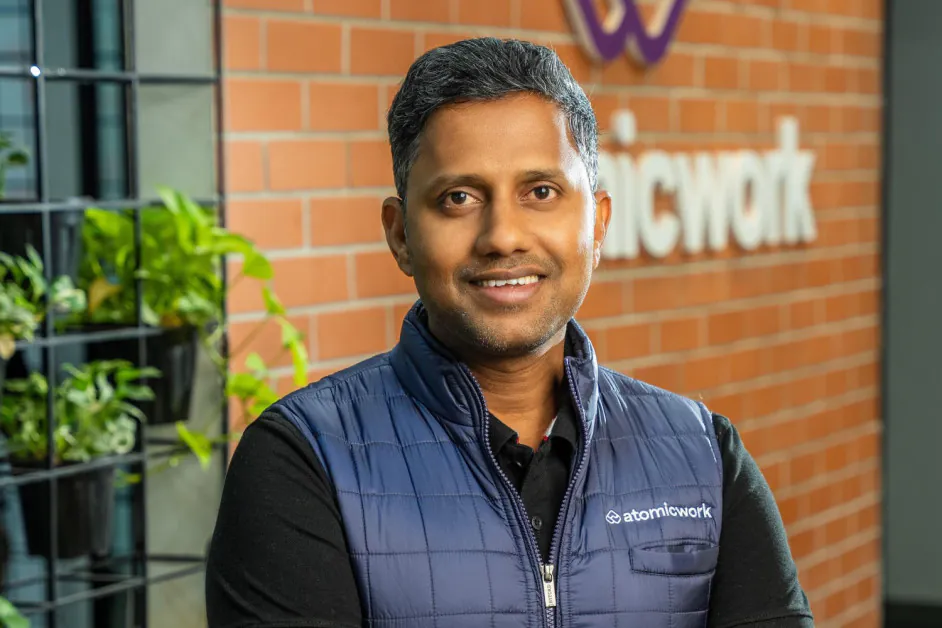
Vijay Rayapati is the co-founder and CEO of Atomicwork. Before founding the company, he served as Senior Vice President and General Manager at Nutanix, where he led the End User Computing business following Nutanix’s acquisition of Frame, the cloud desktop company he founded and scaled as CEO. Earlier in his career, he held engineering and product leadership roles at VMware and Microsoft, giving him deep experience building enterprise infrastructure and end-user computing platforms. His background spans cloud infrastructure, enterprise software, and AI-driven workplace technology, making him a well-known founder in the enterprise IT space.
Atomicwork is an enterprise AI company building an agentic IT service management platform that helps employees resolve technology issues, automate routine support tasks, and access enterprise knowledge through AI. Its platform combines AI agents with modern ITSM capabilities to handle service requests, troubleshoot problems, orchestrate workflows across enterprise systems, and reduce the burden on IT teams. Customers use Atomicwork to deliver faster employee support while improving operational efficiency across IT and business operations.
You previously co-founded Minjar, built its enterprise cloud management business, and then led the operation at Nutanix following the acquisition. What lessons from building, selling, and integrating an enterprise software company convinced you to found Atomicwork in 2022 and rebuild IT service management from the ground up for the AI era?
At Minjar, we built software that could cut a company’s cloud bill by a third through automation. Customers loved the recommendations. Then they’d sit on them for two quarters. It took me a while to understand why, and the answer wasn’t technical. When automation makes a call and it goes wrong, there is nobody to hold accountable. Enterprises don’t just buy softwares or outcomes. They buy someone to answer for them. Software with no place on the org chart doesn’t get authority, no matter how good it is.
The acquisition taught me a narrower lesson. Point products get bought. Systems of record get built on. You can be the better product and still spend your life routing around whoever owns the workflow.
The Nutanix years put the two together. I watched IT buy service management for control and employees experience it as a form and a queue. I also realized the ticket was never the product. The audit trail was. That’s why ITSM survived forty years of people hating it, and it’s also why nobody could remove it.
So the question in 2022 wasn’t whether AI could do the work. It was whether you could give AI a place on the org chart. Legacy ITSM platforms can’t, because a human assignee sits at the center of their data model and every SLA, approval and report hangs off that assumption. Bolt AI on and you get a faster form.
We built for the other answer where AI delivers a hybrid workforce not just software. AI Coworkers do the work, and IT governs them the way HR governs people. You don’t configure an AI Coworker. You hire it into a role, review its work, and revoke it if it doesn’t perform. That’s the difference between AI as a feature and AI as a workforce.
Atomicwork describes its AI Coworkers as systems that own defined job roles and complete work from beginning to end, rather than simply answering questions or executing isolated tasks. What technical capabilities distinguish a genuine AI Coworker from a chatbot, copilot, or traditional automation tool, and where should its autonomy end?
A chatbot answers a question, and a copilot helps someone complete a task, but neither is responsible for carrying the work through to completion. An AI Coworker is different because it is assigned a defined role and expected to deliver an outcome. Whether it is triaging incidents, provisioning access or onboarding employees, it continues working across each step to reach the goal rather than stopping after the first turn.
That requires much more than a capable model. An AI Coworker needs an identity, the right permissions, access to approved tools, organizational context, a budget, and clear operating boundaries and its role. It has to work across business systems, understand when (and who) to ask for approval and leave an audit trail behind every action. That’s why we’ve focused so heavily on the platform around the model. Reliable AI depends on orchestration, governance and execution just as much as intelligence.
Autonomy should never be unlimited. An AI Coworker should operate within the responsibilities of its job role, while people remain involved whenever work affects sensitive systems or carries legal, financial or employment implications.
Your platform allows specialized AI Coworkers to collaborate across incident management, access provisioning, onboarding, and IT operations. How do these AI Coworkers divide responsibilities, share context, and recover when one AI Coworker makes an incorrect decision that could affect the rest of the workflow?
We don’t think one AI Coworker should try to do every job. IT organizations already separate responsibilities across different teams because each role has different goals, permissions and expertise. We’ve applied that same thinking to AI Coworkers which is why we launched with certified AI Coworkers that specialize in different IT operational areas.
Each Coworker owns a specific function while sharing the same enterprise context. When an employee creates a ticket in Atomicwork, smart routing ensures it’s routed to the right AI Coworker that works on the request and (depending on the request) reassigns it to another AI Coworker, creates child tickets for AI Coworkers to resolve the issue in parallel (for example, an onboarding ticket can be split into activities that can be worked on in parallel) or escalates it to a human. As work moves from one Coworker to another, the relevant information moves with it through the ticket (the system of record), along with access to relevant systems such as the service desk, identity platforms, HR systems and collaboration tools. That shared context lets each Coworker make decisions based on what’s already happened instead of starting from scratch.
Atomicwork supports different agent frameworks and models from providers such as OpenAI, Anthropic, and Google. How do you determine which model should handle retrieval, reasoning, planning, and execution, and how can enterprises maintain consistent behavior as the underlying models continue to change?
Different models are good at different kinds of work. Our focus has been on building a platform that can take advantage of advances without forcing customers to redesign their workflows every time a model changes. Enterprise context, orchestration, identity, policy enforcement, telemetry and evaluation provide the consistency that organizations need in production, regardless of which frontier model sits underneath.
We’ve publicly discussed supporting multiple model providers along with evaluation frameworks and governance, but we haven’t described the routing logic that decides which model handles retrieval, reasoning, planning or execution. We also haven’t shared the validation process we use as providers release new models and updates.
An enterprise AI agent may encounter conflicting documentation, incomplete configuration records, outdated knowledge, and different permissions across systems. How does Atomicwork’s Universal Context layer determine which information is trustworthy and current before allowing an agent to make a decision or take action?
Enterprise knowledge rarely exists in one place. Some of it lives in documentation, some in systems of record and some inside the day-to-day activity of the business. AI needs all of that context if it’s going to make reliable decisions.
Universal Context brings those sources together by combining enterprise knowledge with people, network, infrastructure and device data from live operational systems. An AI Coworker can reference information from platforms like Confluence or SharePoint, MDMs like Intune and JAMF, while also understanding what’s happening in systems such as Jira, Workday, Salesforce or identity providers. It also respects existing permissions, so people and AI Coworkers only access information they’re already authorized to see.
We’ve explained how Universal Context connects enterprise systems and preserves security boundaries, but we haven’t described how it resolves conflicting information when trusted sources disagree or how it determines which source should take precedence. Those implementation details aren’t part of our public documentation.
The Universal AI Coworker can support employees through Microsoft Teams, Slack, email, browser, portal and via chat, voice, and visual modes. What new troubleshooting capabilities become possible when an agent can see and hear what the employee is experiencing, and how do you prevent sensitive screen content or conversations from being exposed?
Traditional IT support depends on employees describing technical problems accurately, and that’s often the hardest part of the interaction. Voice and visual context allow the AI to see the same error message, application or configuration screen the employee is looking at, making it much easier to understand the problem and guide someone through the next step without a long back-and-forth conversation.
Those capabilities only work if employees trust them. We believe visual access should require explicit consent and users should always know when it’s active. Sensitive information is protected through PII masking, administrative controls and appropriate retention policies.
We’ve also been clear that customer data isn’t used to train our models or third-party foundation models. That gives organizations the ability to adopt multimodal AI without giving up control over their data.
Atomicwork can be deployed alongside an existing ServiceNow or Jira Service Management environment without requiring an immediate migration. Do you see this primarily as a transition strategy, or will many enterprises permanently operate an AI Workforce above their legacy system of record?
Most large enterprises have spent years building processes, integrations and governance around platforms like ServiceNow and Jira Service Management. Requiring them to replace those systems before they can adopt AI creates unnecessary friction.
We built the Atomicwork integrations with ServiceNow and Jira Service Management so customers can transform the employee experience and augment their service teams with AI Coworkers from day one, without disrupting the systems they already rely on. The connector pulls in relevant enterprise IT context for AI Coworkers to leverage while maintaining a bidirectional sync for service agents in their existing system. We don’t think enterprises should have to choose one path on day one. The priority is helping them adopt AI on their own timeline.
Giving AI Coworkers access to identity systems, employee data, infrastructure, and business applications introduces risks such as prompt injection, poisoned knowledge sources, excessive permissions, and cascading agent errors. What safeguards, approval boundaries, and audit mechanisms are essential before an enterprise can safely allow agents to act autonomously?
AI Coworkers are governed like employees with privileged access. Each Coworker has a defined role, limited permissions, approved tools, spending limits, and clear boundaries on what it can do independently. Sensitive actions—particularly those involving identity, infrastructure, finance, legal matters, or employment—require human approval.
Skills and instructions are vetted before publication for risks such as prompt injection, hidden instructions, credential access, data leakage, and unsafe actions. If a tool changes in a way that increases its risk, it is automatically disabled until reviewed. Additional safeguards—including action limits, duplicate-action prevention, emergency shut-off controls, and human takeover—help contain errors before they can spread.
Every action is traceable: organizations can see what triggered the Coworker, what information and tools it used, which approvals were obtained, and what outcome followed. Ongoing evaluation, monitoring, and red-team testing ensure these safeguards remain effective as models, tools, and enterprise environments evolve.
We’ve invested heavily in evaluation, policy enforcement, monitoring and red-team testing because deploying AI is only the beginning. Organizations need confidence that those Coworkers continue behaving as expected as models and enterprise environments evolve.
Atomicwork’s State of AI in IT 2026 report found that two-thirds of IT professionals are reporting positive returns from AI investments, while only one in five organizations have fully embedded AI across their service management teams. What separates deployments that produce measurable business value from pilots that remain stuck in experimentation?
Most organizations have already shown that AI can improve individual tasks. The companies seeing measurable business value are connecting AI to complete operational workflows rather than using it as a standalone assistant.
That starts with solving a specific business problem by thinking in roles, giving AI Coworkers access to the systems it needs and measuring outcomes that matter – whether that’s faster resolution times, lower support costs or a better employee experience. Once teams trust those results, expanding AI across additional workflows becomes much easier.
Our research also found that responsible AI remains one of the highest priorities for IT leaders. That makes sense because organizations won’t give AI more responsibility unless they understand how it reaches decisions, can review those decisions afterward and know the right guardrails are in place.
As AI Coworkers begin resolving support requests, managing access, diagnosing incidents, and coordinating workflows, how will the responsibilities of service desk professionals, IT operations teams, and Chief Information Officers change? Looking further ahead, could IT become the department responsible for hiring, governing, and measuring an enterprise’s entire digital workforce?
AI will take over much of the repetitive operational work that consumes today’s service desks, allowing people to spend more time handling exceptions, improving processes and refining the knowledge AI depends on.
IT operations teams will increasingly focus on governing AI Coworkers instead of manually executing every workflow. They’ll define permissions, connect systems, monitor performance and make sure AI continues operating within established policies.
I also expect the CIO’s role to expand. Managing hundreds of AI Coworkers starts to resemble managing any other enterprise infrastructure. Someone has to decide what those Coworkers can access, how they’re measured, when they’re updated and whether they’re delivering value. Business teams will continue defining the work, while IT becomes the HR for AI aka responsible for the platform, governance and operational controls that keep an enterprise AI workforce running safely.
Thank you for the great interview, readers who wish to learn more should visit Atomicwork.
