

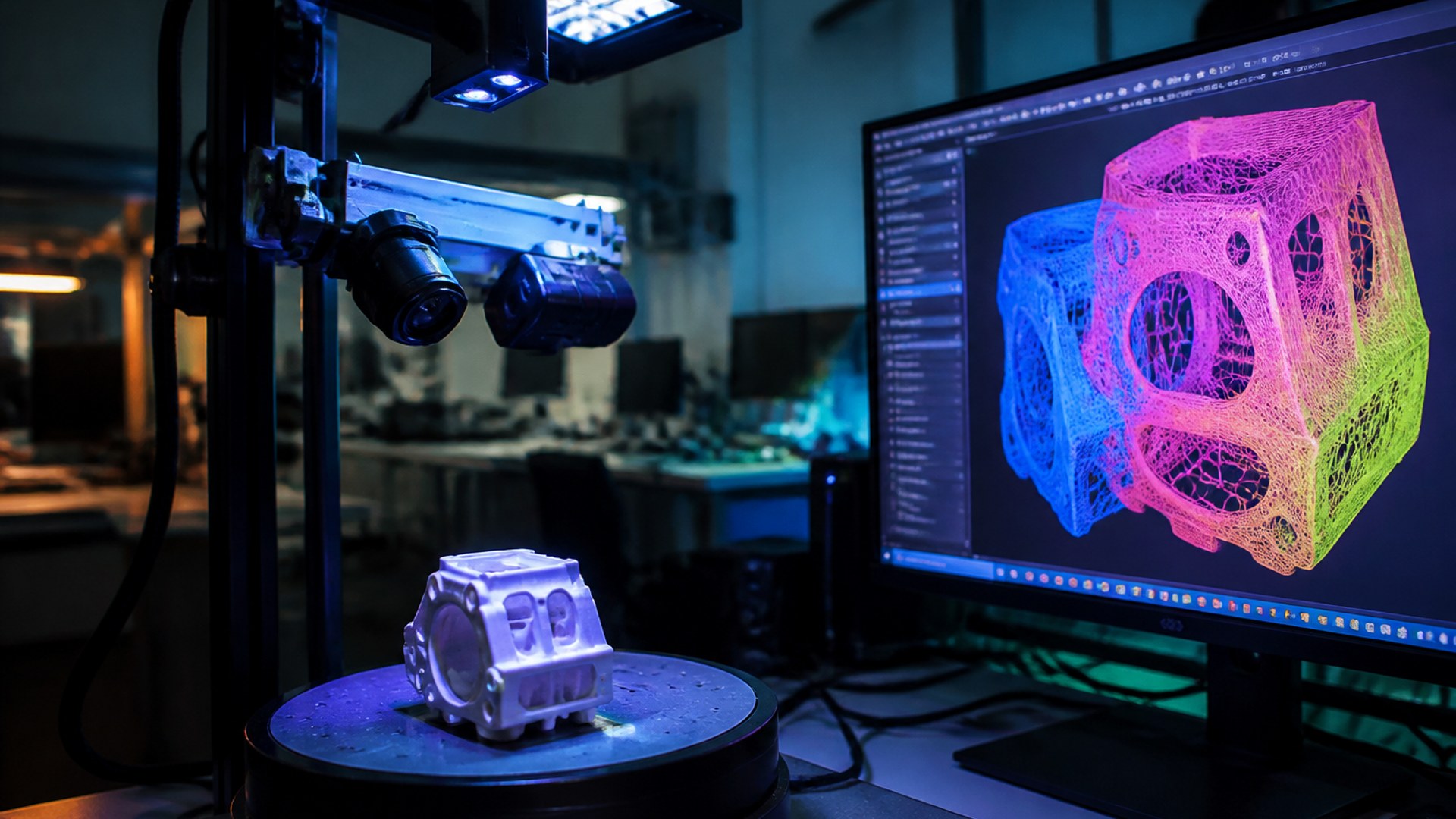
Meshy has released Meshy 7, its new image-to-3D foundation model, pairing the launch with something the 3D generation field has largely lacked: a geometry benchmark that scores a generated model directly against a known correct answer. In the company’s announcement, published August 12, 2026, Meshy says Meshy 7 leads every model tested on all three of the benchmark’s alignment metrics, posting 81.0% on overall proportion, 79.7% on spatial distribution, and 59.8% on surface details against four competing 3D foundation models.
The release is built around a single claim about what image-to-3D evaluation should measure. Early failures in this category were obvious: broken surfaces, scrambled structure, missing limbs. Those are now rare enough among leading models that merely not breaking differentiates very little, the company argues. The failure mode that remains is subtler: an asset can look entirely reasonable and still fail to reproduce the reference, with a body slightly too wide, a hand shifted out of place, or an engraved line from the source image simply gone. Meshy calls that property alignment, and it is the quantity Meshy 7 was trained and evaluated against.
A Benchmark With a Known Correct Answer
The more interesting part of the announcement, for anyone who reads evaluation methodology before capability claims, is how the benchmark is constructed. It uses neither human preference scoring nor a vision-language model as judge. Instead, reference 3D models held out of training are rendered into input images using known cameras, each generative model produces a 3D result from those images, and the output is compared directly against the original reference geometry. Every test image carries a known 3D correct answer.
Two design choices do the load-bearing work. Comparing generated geometry to reference geometry, rather than comparing renders, avoids having to estimate the source camera first, which would mix camera error into the geometry error being measured. And before scoring, each generation is aligned to its reference by translation, rotation, and uniform scaling only, never stretched along a single axis, so a model’s own proportion errors cannot be corrected away by the evaluation harness. Agreement is then measured at three levels, from overall structure down to fine geometric difference, across a reference set spanning characters, vehicles, sculptures, and thin-structure props, under three input conditions: front view, raised top-quarter view, and four views combined.
These are vendor-reported numbers on a benchmark the vendor itself designed, and the usual discount applies. That said, the structural choices, held-out references, direct geometric comparison, and no per-axis rescaling, are the choices an honest measurement would make, and Meshy says the benchmark will be released separately after launch, which would let outside labs run their own models through it.
Where Meshy 7’S Lead Is Widest
The pattern in the results matters more than the topline. Overall proportion is close across leading models now, so a lead there means little. Surface details is where no tested model reaches 60% under single-view input, and it is where Meshy 7 pulls furthest ahead: 5.3 points clear of the closest competitor, more than twice its margin on either of the other two aspects. Under the front view, the strictest single-image condition, the company says Meshy 7 leads on aggregate and on each metric individually.
With four views the field converges. Every model improves, extra views help most on spatial distribution and surface details, the dimensions most affected by hidden geometry, and the leaders end up within roughly two points of one another, with Meshy 7’s closest competitor catching up rather than clearly overtaking. Single-view input, the company notes, is both where systems separate and the condition most users are actually in. Compared with its predecessor, Meshy 7 improves alignment on both geometry and texture against Meshy 6, with texture measured separately.
Meshy attributes the gain to three changes. The image encoder now reads the input at multiple scales and accepts higher resolution, so fine shape information survives into generation instead of being averaged out. The training data was rebuilt so that every sample corresponds exactly to its target geometry, with style, lighting, and background removed. And geometry alignment became a tracked signal inside every training cycle rather than an evaluation applied at the end, so the capability users care about and the number the team optimizes against are now the same number.
The qualitative examples the company ships with the release map onto the metrics. On portrait busts, cheeks lift and laugh lines deepen on a smile while a headscarf and clothing stay stable, a test of whether small geometric changes survive. On a clockwork owl of layered wing armor, exposed gears, and thin legs, the parts stay distinct and placed as the concept places them. On a jade medallion, dense shallow relief stays continuous at the depth the image gives it rather than fragmenting.
What Ships and What Comes Next
Meshy 7 went live on August 10, 2026, open to all Meshy subscription tiers, and the company’s site now leads with the release. Downloading generated models requires the Pro tier or above. Ultra Mode currently supports single-view generation, with multi-view support arriving shortly, which matters given how much the four-view condition closes the gap in the company’s own results.
Two scheduled follow-ons are worth tracking. The geometry benchmark described in the release will be published separately after launch. And because geometry is only one component of image-to-3D alignment, with color, material, and pattern carrying their own, a dedicated texture alignment benchmark will follow. Publishing the harness is what would turn a vendor claim into a number other labs have to answer.
The release lands in a 3D foundation model market that has been consolidating around a few serious players: Tripo AI raised $150 million in July 2026 as the category pushed toward interactive world generation, and Meshy itself raised nearly $400 million in a Series B at a $1.5 billion valuation earlier this summer. Unite.AI’s own hands-on review of Meshy found the platform’s strength in exactly the workflow this release targets, turning a single 2D concept into a usable asset. The independent test of Meshy 7’s central claim will arrive when the benchmark does: whether the alignment lead holds on references nobody at Meshy chose.
