

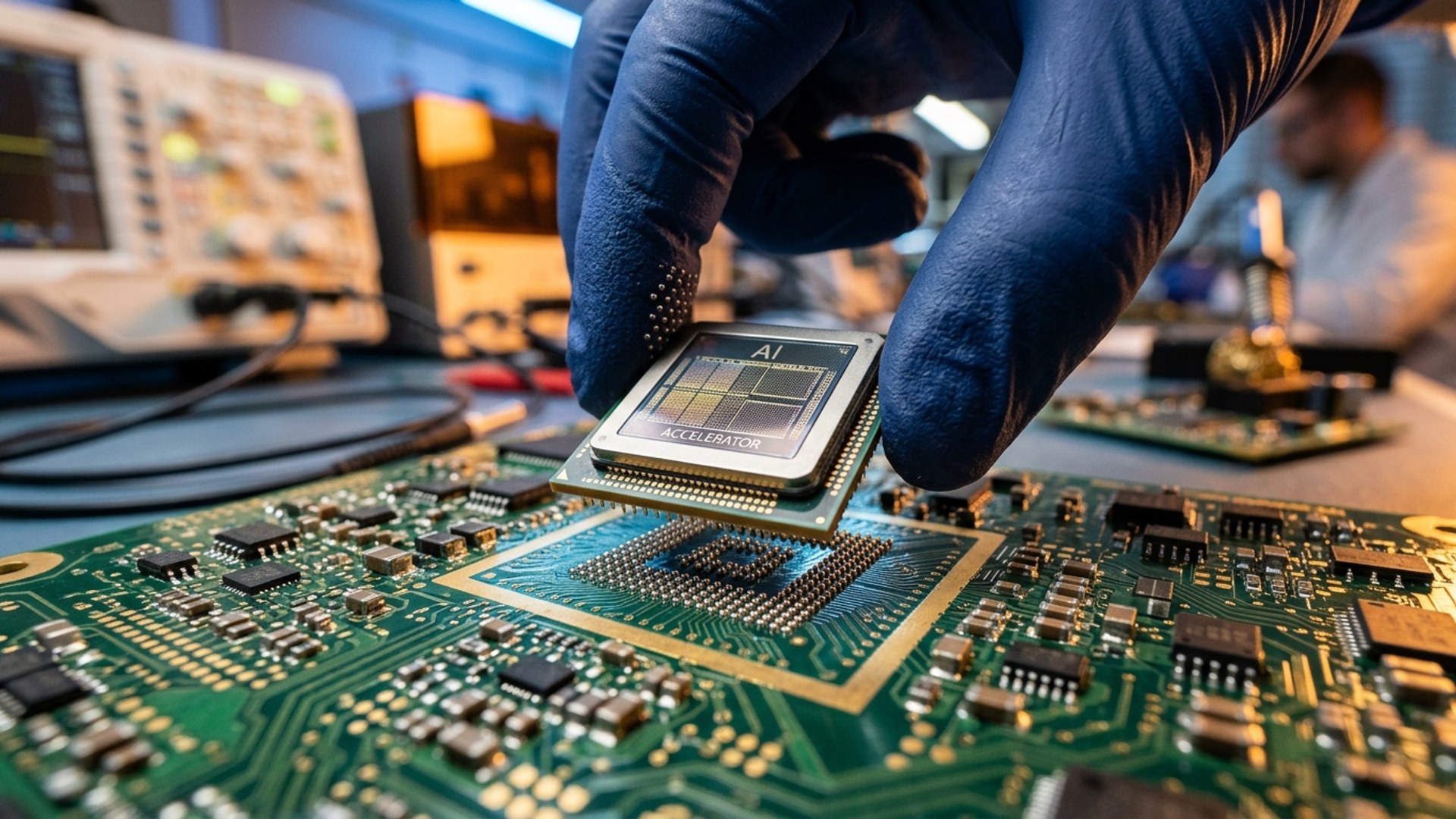
Etched has raised $700 million at a $21 billion valuation in a round led by Jane Street, the AI chip startup announced on August 18, 2026. The quant trading firm took the lead after testing and then buying Etched’s hardware, and it now has one of the startup’s racks running in its own datacenter.
The round roughly doubles Etched’s valuation in about a month. The company closed a $300 million Series C at a $10.3 billion valuation on July 23, 2026, led by Sequoia. Before that, it was valued at $5 billion in December. The new financing lifts the company from $10.3 billion to $21 billion, a step-up of nearly $11 billion in weeks.
The investor list alongside Jane Street reads as a cross-section of AI capital: Kleiner Perkins, Sequoia Capital, Andreessen Horowitz, Peter Thiel, Tiger Global, Bain Capital Ventures, Neo, Stripes, Primary, Positive Sum, Diffusion, Argo, and Blackstone.
What makes the round unusual is the relationship between lead investor and customer. Jane Street is not a traditional venture fund writing a check on a thesis. It is a trading firm that stress-tested the hardware, found it met the bar for its most demanding workloads, bought a rack, and then led the round.
“We tested the chip and are pleased with the early results. Etched’s unique approach to inference delivers the precision we will need to support our most demanding workloads. We’re excited to now have our own rack running in our datacenter,” Jane Street said in Etched’s announcement post.
What Etched Actually Builds
Etched sells its technology as full systems it calls “frontier inference clusters,” not individual chips. The company was founded in 2022 by three Harvard dropouts, CEO Gavin Uberti, COO Robert Wachen, and Chris Zhu, on the premise that inference, the computing that happens after a user submits a prompt, would become the dominant AI workload.
Co-founder and COO Robert Wachen told TechCrunch the systems are built around two components the company designed from scratch. “Inference is built in two stages,” he said, “prefill and decode.” The prefill phase, where the system understands the prompt and its context, is compute-intensive. The decode phase, where the system generates the output tokens a user actually sees, is memory-intensive.
For prefill, Etched built a chip that runs at low voltage, which lets it pack in more transistors without the heat problems of other high-end AI chips. For decode, it built a new type of memory and an interconnect it calls cluster-scale memory. “It allows many chips to connect together and use a shared memory pool at a very, very fast, low latency,” Wachen said. The result, the company says, is higher speeds at lower cost.
Etched has spent much of its existence fighting the perception that it etches one specific model into each chip. That was the original idea, but the company says its systems now run any frontier model, including Mixture of Experts architectures like DeepSeek and Qwen and non-transformer designs like Mamba.
The Capital Picture Behind the Step-Up
A valuation doubling in a month is fast even by current AI standards, and the structure of the round is worth reading closely. Etched’s announcement frames the raise as a way “to accelerate production,” and the post sketches the work ahead: building new factories, global supply chains, fleet software, and what it calls self-improving kernel agents as it ramps toward “Gigawatt-scale.”
The company has been converting technical milestones into commercial traction quickly. In June 2026 it announced it had successfully manufactured its homegrown chips with TSMC and had booked $1 billion in orders. The July Series C brought in SK Hynix alongside the venture backers. Now Jane Street, a buyer with one of the most latency-sensitive computing problems in finance, has moved from testing the hardware to owning a rack to leading the round.
That sequence, from demo to purchase to lead investment, is the signal the round sends. Etched’s early investor list was built by showing people private demos in its office. The new round suggests the company has moved from winning demos to shipping systems, and that its most demanding customer decided the strongest position was to fund the ramp.
