

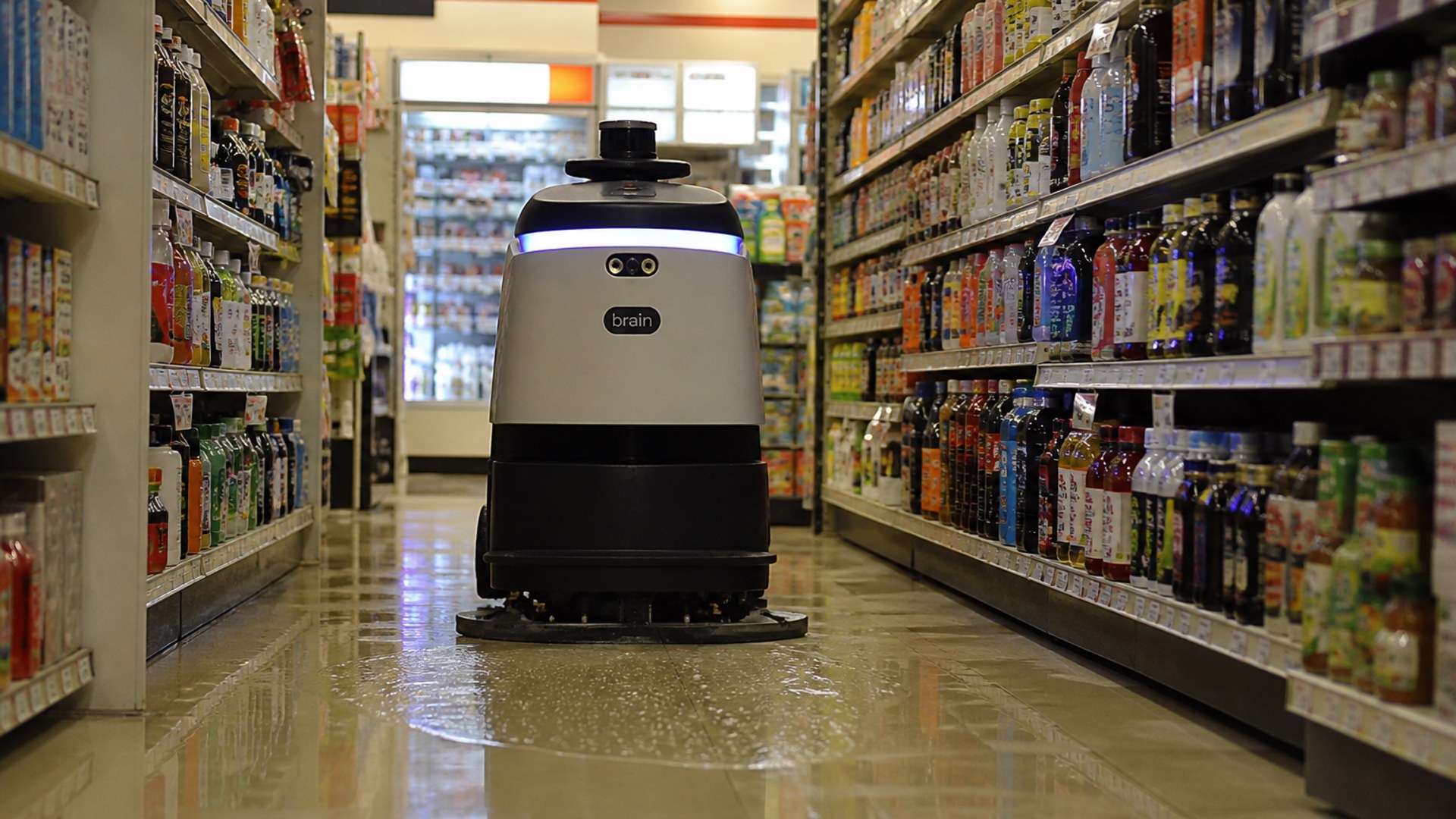
Pudu Robotics launched the PUDU ET1 on August 12, 2026, an AI-native compact scrubber-dryer robot built for commercial spaces of 100 to 800 square meters, taking the Shenzhen company’s cleaning lineup down into the convenience stores, drugstores, and chain restaurants too tight for its larger machines.
The ET1 is the first product in a new PUDU E Series, the company said in its launch announcement. Target deployments include convenience stores, drugstores, chain restaurants, business and economy hotels, and office spaces, the kind of high-frequency, space-constrained floors where full-size scrubber robots are difficult to maneuver and smaller machines have historically leaned on more manual intervention.
The robot combines scrubbing, sweeping, vacuuming, and dust-mopping in a single chassis, arranged in a front-sweep, rear-scrub layout so it handles dry debris and wet stains in one pass. Scrubbing comes from a roller spinning at up to 800 rpm against 20 kPa of suction, and the company says the machine recovers dirty water quickly enough to leave floors dry behind it, a slip-risk consideration in spaces that stay open to customers while cleaning runs.
For sticky stains in restaurants and retail, the ET1 supports 85°C hot-water scrubbing. The docking station supplies the hot water and onboard heating maintains temperature during operation, according to the ET1 product page.
The Docking Station Does the Daily Maintenance
The ET1’s pitch to small-format operators rests less on the robot than on what happens between cleaning runs. The 8-in-1 docking station automates charging, clean-water refilling, wastewater drainage, detergent dosing, roller mop rinsing, squeegee rinsing, roller spin-drying, and water heating. After each task the robot returns to the dock and runs a self-cleaning cycle, and a separate auto dust-collection step transfers dust, hair, and debris into a 2.5-liter onboard container that Pudu says needs emptying roughly once a week.
The headline figures from the ET1 specification sheet:
- Cleaning coverage: 100–800 m² target spaces, at 300–720 m²/h cleaning efficiency
- Cleaning width: 30 cm scrubbing and dust-mopping, 39 cm sweeping and vacuuming
- Tanks and dust box: 8 L clean water, 7.2 L wastewater, 2.5 L dust box
- Dimensions and mass: 500 × 380 × 580 mm, approximately 45 kg
- Minimum clearance: 50 cm wide, 60 cm high
- Runtime: 2.5–4 hours from a 35 Ah battery, with roughly 3 hours to recharge
- Top cruise speed: 1.0 m/s
The clearance numbers are the deployment-critical ones. A 50 cm aisle width and 60 cm height clearance let the robot pass between shelving rows and under fixtures in convenience stores and drugstores, and Pudu says the machine is quiet and compact enough to operate during business hours rather than only after close.
AI Magic Cleaning Adjusts the Scrub to the Floor
Pudu groups the ET1’s perception and control stack under what it calls AI Magic Cleaning, which ties mapping, stain recognition, cleaning heatmaps, and adaptive cleaning into one workflow. Auto Mapping with a one-click start removes the pre-mapping step, so a store team can power the robot on and begin cleaning without a setup visit.
The surface-recognition layer does specific mechanical work. When the robot detects a carpet edge it lifts the scrubbing roller to keep the carpet dry; over liquid spills it lifts the sweeping brush and side brush to avoid spreading the mess. When it identifies a stubborn stain, an adaptive scrubbing mode drops cruise speed, raises roller speed, and increases water output in one pass.
One option extends the machine past cleaning: a 21.5-inch advertising display with cloud-based content management, plus customizable body wraps, turning the robot into a mobile in-store marketing surface. Autonomous machines working public retail floors increasingly double as customer-facing fixtures, a pattern that has reshaped how autonomous mobile robots operate in retail environments.
Where the ET1 Sits in Pudu’s Lineup
The E Series fills the bottom of a cleaning portfolio that already spans mid-size and large machines. The CC1 Series covers intelligent commercial cleaning, the MT1 line handles AI-powered sweeping, and the BG1 Series targets large commercial complexes, supermarkets, warehouses, and logistics facilities. With the ET1, Pudu now fields a scrubber-dryer at each floor-size tier, from a single drugstore aisle to a distribution center.
The launch also lands inside a broader corporate bet. Pudu describes its product strategy as a One Brain, Multiple Embodiments architecture spanning specialized, semi-humanoid, and humanoid robots, with the cleaning line sharing an AI-native technology roadmap with the rest of the catalog. That framing, one perception-and-decision stack reused across many robot bodies, is the same architectural wager driving current embodied-AI research built on large language models, applied here to a commercial product category where reliability per dollar matters more than general-purpose capability.
Pudu cites Frost & Sullivan’s 2025 Global Embodied Intelligence and Commercial Service Robotics report as ranking it first globally in commercial cleaning robotics revenue with a 29% market share, and first in commercial service robotics overall by both revenue and shipment volume. The company says it has shipped more than 130,000 robots across over 85 countries and regions to date.
The ET1 enters that installed base as the smallest scrubber-dryer Pudu sells, aimed at the storefront tier of the market where a single location might run one machine and a chain brand might run thousands. For chain operators, the company is selling the deployment math directly: no pre-mapping, a manager mode and a simplified daily-operator mode, and modular cleaning components that release in about 30 seconds for washing.
