

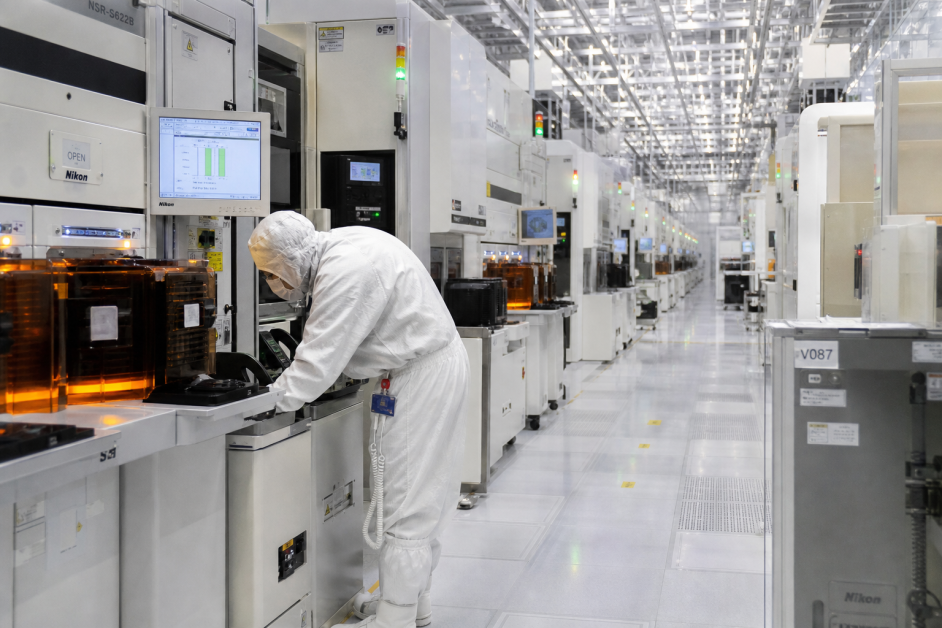
SK hynix’s (SKHYV ) board has approved a combined 54 trillion won (roughly $39 billion) for two new fabrication plants, the company announced on August 7, 2026: 35.2 trillion won for “Y2,” the second fab at its Yongin Semiconductor Cluster, and 19.1 trillion won for “M17,” a new NAND fab in Cheongju. The two projects expand production capacity for both halves of the memory business that AI infrastructure now runs on: DRAM for high-bandwidth memory, and NAND flash for the enterprise SSDs piling up behind AI inference.
Y2 is the bigger check and the longer wait. Ground breaks in July 2027 on a DRAM plant with about 1.13 million square meters of floor area, and its first cleanroom opens in June 2029 to produce HBM and other next-generation DRAM. M17, at roughly 680,000 square meters, breaks ground earlier (February 2027) and opens its first cleanroom in December 2028. Y2’s investment period runs through October 2031, M17’s through April 2031.
Both fabs are executions of the mid-to-long-term investment strategy SK hynix laid out in June 2026, a 1,100 trillion won program spanning Yongin (600 trillion won), Cheongju (100 trillion won), and a future Southwestern Region production hub (400 trillion won). The board approvals turn the first two arms of that master plan from announced intentions into funded construction schedules.
The demand case SK hynix cites is specific. Market research firm Omdia projects both DRAM and NAND demand growing at a 19% compound annual rate from 2025 through 2030, and the company is treating that as structural rather than a supercycle to ride. Its stated logic: supplying the required volume at the exact moment customers need it is now the competitive advantage, not technological leadership alone.
What 54 trillion won buys, fab by fab
Y2 is the second of four fabs planned sequentially for the Yongin cluster in Gyeonggi-do, a site sprawling across about 4.16 million square meters. The first, Y1, is already under construction with its initial cleanroom targeted for February 2027. SK hynix has pulled the full cluster’s completion forward 12 years, from 2045 to 2033, and Y2 is the second phase of that accelerated schedule. The 35.2 trillion won covers more than wafer capacity: it includes a business support building, an integrated R&D center for product development testing and analysis, and auxiliary infrastructure from water treatment to substations.
The power and water question that shadows every fab announcement has a documented answer here, at least for this phase. Phase 1 infrastructure for the cluster, everything required through Y2’s operation, is at a 99% completion rate, with fab construction and utility buildout running concurrently.
M17’s siting is a speed decision. Cheongju already houses the M11, M12, and M15 fabs, so the new plant plugs into existing operations and pre-built power and water infrastructure, which the company says gives it the fastest construction timeline of any option. The NAND it will produce is riding a demand driver that barely existed two years ago: enterprise SSDs for AI services, plus key-value cache storage for inference workloads, where storing previously computed vectors avoids redundant calculation as agentic AI applications multiply.
Notably, the shell and the capacity are decoupled. Fabs go up on the master schedule, but cleanroom expansion and equipment installation happen sequentially in line with customer demand — a structure that lets SK hynix commit construction capital now while metering the far larger equipment spend against orders.
- 54 trillion won: total board-approved investment across Y2 and M17
- 35.2 trillion won: Yongin Y2, a DRAM fab of ~1,130,000 m², investing through October 2031
- 19.1 trillion won: Cheongju M17, a NAND fab of ~680,000 m², investing through April 2031
- 19%: projected CAGR for both DRAM and NAND demand, 2025 through 2030, per Omdia
- 99%: completion rate of the Yongin cluster’s Phase 1 power and water infrastructure
The buildout so far
The strategy behind these two fabs has been assembling in public for months. SK hynix is already constructing Y1, the first Yongin fab, with its initial cleanroom targeted for February 2027. In June, it set the full 1,100 trillion won framework, including 100 trillion won for Cheongju covering M17 and a P&T7 advanced packaging facility. The same period has seen the company deepen its demand-side ties, including a multi-year technology partnership with NVIDIA (NVDA ) on memory for AI factories. HBM supply is exactly the constraint our coverage of the current RAM shortage traced through the supply chain — and today’s approvals are what a supply response looks like at fab scale, with fab-scale lag times.
What lands next is a sequence of construction milestones: M17 breaks ground in February 2027, Y1’s first cleanroom opens the same month, Y2 breaks ground in July 2027, M17’s cleanroom opens in December 2028, and Y2’s follows in June 2029. The equipment that turns those shells into wafer starts arrives only as customer demand does, so the gap between the two dates is where SK hynix’s real production answer to AI memory demand will be decided.
