

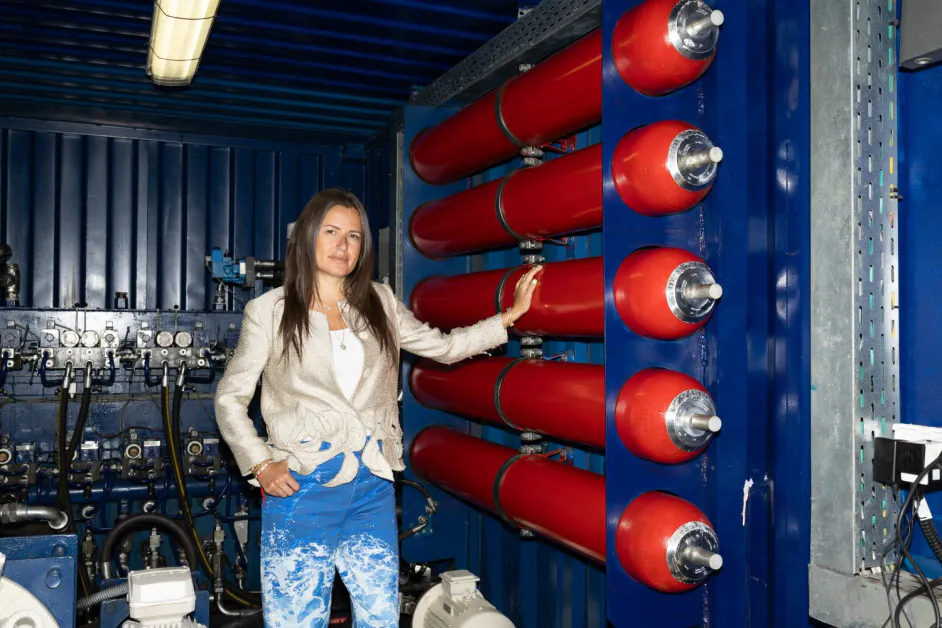
Inna Braverman, Founder and CEO of Eco Wave Power – is a technology entrepreneur working to establish wave energy as a commercially viable source of renewable electricity. She founded Eco Wave Power in 2011 at the age of 24, inspired in part by her personal connection to the Chernobyl nuclear disaster and a commitment to reducing pollution. Under her leadership, the company has developed grid-connected wave energy installations, built an international project pipeline and gained recognition from organisations including the United Nations, the European Union and Israel’s Ministry of Energy. Braverman has also delivered several TEDx talks and has been featured by CNN, Wired and Smithsonian for her work in renewable energy and entrepreneurship.
Eco Wave Power is a Nasdaq-listed renewable energy company developing technology that converts the movement of ocean and sea waves into electricity. Its system attaches floaters to existing coastal structures such as breakwaters, jetties and piers, allowing much of the power-generation equipment to remain safely on land while avoiding complex offshore construction and seabed connections. The company operates Israel’s first grid-connected wave energy station, has launched a pilot installation at the Port of Los Angeles and is advancing projects in Portugal, Taiwan and India as part of a reported 404.7-megawatt global project pipeline.
You were born just weeks before the Chernobyl nuclear disaster, an experience that has profoundly shaped your outlook on energy and the environment. How did that early story inspire you to co-found Eco Wave Power, and what convinced you that wave energy could succeed where so many previous efforts had struggled?
I was born in Ukraine just a few weeks before the Chernobyl nuclear disaster. Although I was too young to remember it, I grew up with its consequences. I saw firsthand how a single energy-related catastrophe could affect millions of people, communities, and the environment for generations. That experience gave me a deep appreciation for the importance of developing clean, reliable, and safe sources of energy.
Years later, while studying and exploring different renewable energy technologies, I realized that although our planet is covered mostly by water, wave energy remained one of the least developed renewable resources. At the same time, I noticed that many earlier wave energy companies had struggled because they deployed large, expensive systems offshore, where installation and maintenance are extremely difficult and costly.
That observation led me to a different approach. Instead of fighting the ocean, why not work with existing coastal infrastructure? Eco Wave Power’s technology is installed onshore or on man-made marine structures such as piers, breakwaters, and jetties, making it easier, safer, and more cost-effective to install, maintain, and scale. By avoiding offshore deployment, we significantly reduce operational complexity while making wave energy commercially viable.
What convinced me this approach could succeed was its simplicity. Innovation doesn’t always mean making something more complicated, it often means removing unnecessary complexity. Today, after years of engineering, testing, and operating grid-connected projects, we have demonstrated that wave energy can become a practical addition to the global renewable energy mix. As electricity demand continues to grow, particularly with the expansion of AI infrastructure and data centers, I believe wave energy has an increasingly important role to play in delivering predictable, renewable power where it’s needed most.
NVIDIA (NVDA ) recently highlighted Eco Wave Power’s use of AI infrastructure and Omniverse digital twins to optimize wave energy systems. How has artificial intelligence changed the way you design, deploy, and operate wave energy projects compared to traditional engineering approaches?
Artificial intelligence is fundamentally changing how renewable energy infrastructure is designed and operated, and wave energy is no exception. Traditionally, engineering decisions were based on static models, historical datasets, and a significant amount of manual analysis. AI allows us to move from reactive engineering to predictive engineering.
At Eco Wave Power, we are integrating AI into multiple layers of our technology. Using NVIDIA’s AI infrastructure and Omniverse digital twins, we can create virtual replicas of our wave energy installations that continuously incorporate real-world operational and ocean data. This enables us to simulate different sea conditions, optimize the positioning and performance of our floaters, predict maintenance needs before failures occur, and continuously improve system efficiency without interrupting operations.
AI is also helping us analyze vast amounts of wave and environmental data much faster than would be possible using traditional methods. That allows us to make better site selection decisions, optimize future project designs, and shorten development timelines.
Looking ahead, we believe AI will become an essential component of renewable energy infrastructure. Just as AI is transforming industries from healthcare to manufacturing, it can also make clean energy systems smarter, more reliable, and more efficient. Our vision is to combine the predictability of engineering with the adaptability of artificial intelligence, creating wave energy systems that continuously learn and improve over time. That combination has the potential to accelerate the commercialization of wave energy and strengthen its role in the global energy transition.
AI data centers are creating unprecedented demand for electricity, particularly in coastal regions where cooling and new generation capacity are available. Do you believe AI could become the catalyst that finally brings wave energy into the mainstream, and why is this moment different from previous clean energy cycles?
I believe AI is creating one of the most significant shifts in electricity demand we’ve seen in decades. Data centers are no longer consuming just megawatts, they are increasingly planning for hundreds of megawatts, and eventually gigawatts, of reliable, clean electricity. Many of these facilities are being built in coastal regions because of access to cooling water, fiber connectivity, and available land. Coincidentally, that’s exactly where wave energy is naturally available.
What makes this moment different is that, for the first time, there is a customer with an urgent need for additional renewable energy, not just because of sustainability goals, but because electricity itself is becoming a limiting factor for growth. AI companies cannot scale without power, and every new source of clean, predictable electricity becomes strategically valuable.
Wave energy is particularly well positioned because it complements other renewable sources. Solar generates during the day, wind depends on changing weather conditions, while waves often continue producing energy even after the wind has subsided. Together, these technologies create a more balanced and resilient renewable energy portfolio.
I also think the industry itself has matured. Technologies have improved, artificial intelligence is enabling better optimization and predictive maintenance, digital twins allow us to test and refine systems before deployment, and governments and infrastructure owners are increasingly looking for innovative ways to maximize the value of existing coastal assets.
At Eco Wave Power, we don’t see ourselves as competing with solar or wind, we see ourselves as adding another important layer to the renewable energy mix. If AI becomes the driver that accelerates investment in reliable coastal renewable infrastructure, then wave energy stands to benefit significantly. I believe this convergence of rising electricity demand, advances in AI, and the need for energy diversification makes this a very different moment from previous clean energy cycles.
Wave energy has often been viewed as technically promising but commercially challenging. What breakthroughs in engineering, infrastructure, or economics have most improved its commercial viability over the past decade?
I think the biggest breakthrough has actually been a change in philosophy.
For many years, the wave energy industry focused on deploying large, complex systems far offshore, where the ocean is at its most powerful, but also at its most unforgiving. Those projects faced extremely high installation, maintenance, and survivability costs, making commercialization very difficult.
At Eco Wave Power, we chose a different path. Instead of building massive offshore structures, we developed a technology that attaches to existing man-made marine structures such as breakwaters, piers, and jetties. By utilizing infrastructure that already exists, we significantly reduce installation costs, simplify maintenance, and improve accessibility while still capturing the energy of ocean waves.
Beyond engineering, several broader developments have improved the commercial outlook for wave energy. Digitalization, AI, and predictive maintenance technologies enable us to optimize performance and reduce operating costs. Advances in sensors, control systems, and simulation tools allow us to refine designs much faster than was possible a decade ago. At the same time, ports and coastal infrastructure owners are increasingly looking for ways to generate clean electricity from assets they already own.
Perhaps most importantly, the economics of renewable energy have changed. A decade ago, wave energy was often viewed as competing with other renewables. Today, the conversation is different. With electricity demand rising rapidly, driven by electrification, industrial growth, and AI infrastructure,the world needs more clean energy from more sources. Wave energy is increasingly recognized as a complementary technology that can strengthen energy resilience and diversify the renewable energy mix.
Commercial success ultimately comes from delivering reliable energy at a cost customers can justify. I believe the combination of existing infrastructure, technological advances, and today’s unprecedented demand for clean electricity has created the strongest commercial foundation the wave energy industry has ever had.
Eco Wave Power’s technology takes a different approach by attaching floaters to existing coastal infrastructure while keeping critical equipment onshore. What advantages does this architecture provide in terms of maintenance, reliability, scalability, and project costs?
Our technology was designed around one simple question: How do we make wave energy practical, not just possible?
Instead of placing complex electrical and hydraulic equipment offshore, where it is difficult and expensive to access, we attach our floaters to existing coastal infrastructure such as breakwaters, piers, and jetties, while keeping the critical conversion equipment safely onshore.
That architecture creates several important advantages. First, maintenance becomes much simpler and significantly less expensive. Technicians can service the hydraulic and electrical equipment from land without requiring specialized vessels, divers, or favorable weather windows. This reduces both operating costs and downtime.
Second, reliability improves because the most sensitive components are protected from the harsh offshore marine environment. Saltwater, corrosion, and extreme storms present major challenges for offshore equipment. By locating critical systems onshore, we reduce exposure to those risks and extend equipment life.
Third, scalability becomes much more straightforward. Around the world, there are thousands of kilometers of existing marine infrastructure that can potentially host our technology. Rather than constructing entirely new offshore platforms, we can integrate with assets that already exist, which can accelerate permitting, simplify deployment, and lower capital costs.
Finally, this approach improves project economics. Lower installation costs, easier maintenance, and higher equipment accessibility all contribute to reducing the overall cost of generating electricity. That’s essential because commercial success isn’t just about proving that a technology works, it’s about making it economically competitive and attractive to customers and investors.
We believe our onshore architecture is one of the key reasons Eco Wave Power has been able to move from concept to grid-connected operation and continue expanding internationally. It reflects our broader philosophy that innovation should simplify renewable energy deployment rather than make it more complicated.
Digital twins are becoming increasingly important across industrial AI. Beyond improving simulations, how do you see AI-powered predictive maintenance, environmental forecasting, and operational optimization reshaping the economics of renewable energy projects?
I think we’re only at the beginning of what AI can do for renewable energy. Digital twins are often viewed as advanced simulation tools, but I believe their real value is that they enable renewable energy assets to become continuously learning systems.
By combining digital twins with AI, real-time sensor data, and environmental forecasting, we can move from reacting to problems to anticipating them. Predictive maintenance allows us to identify early signs of wear before a component fails, reducing downtime, extending equipment life, and lowering maintenance costs. For infrastructure that is expected to operate for decades, those improvements can have a significant impact on the overall economics of a project.
Environmental forecasting is another major opportunity. More accurate wave, weather, and ocean condition predictions enable operators to optimize energy production, plan maintenance during favorable conditions, and better manage grid integration. Rather than simply responding to the environment, renewable energy systems can proactively adapt to it.
AI also enables continuous operational optimization. As more data is collected over time, algorithms can identify patterns that humans might miss, helping improve control strategies, increase energy capture, and inform the design of future projects. Every installation effectively becomes a source of knowledge that benefits the next one.
More broadly, I believe AI is becoming the intelligence layer of renewable energy infrastructure. Just as renewable technologies generate clean electricity, AI helps ensure that electricity is produced more efficiently, more reliably, and at a lower lifetime cost.
At Eco Wave Power, we see digital twins and AI as key tools for accelerating commercialization. They help reduce technical risk, improve operational performance, and strengthen investor confidence by making renewable energy projects more predictable, more efficient, and ultimately more bankable.
Much of the world’s AI infrastructure is expected to be built near ports and coastal regions. How realistic is the vision of directly pairing wave energy with AI data centers, and what technical or regulatory hurdles still need to be overcome before that becomes commonplace?
I believe it is not only realistic, it is one of the most compelling opportunities for the next generation of renewable energy.
The AI revolution is creating an unprecedented demand for electricity, and many of the world’s new data centers are being built in coastal locations because they offer access to cooling water, subsea fiber-optic cables, ports, and available industrial land. Those same coastlines represent an enormous, largely untapped renewable energy resource.
Unlike concepts that may take decades to commercialize, wave energy is available today. At Eco Wave Power, our technology is designed to be installed on existing coastal infrastructure such as breakwaters, piers, and jetties, allowing us to move from contract signing to commercial deployment in approximately 18 to 24 months. In the energy sector, where new generation projects often require many years to develop, that is an exceptionally fast timeline.
I absolutely see wave energy supplying electricity directly to coastal facilities, including AI data centers. Not necessarily as the sole source of power, but as an important part of an integrated energy system that combines wave energy with solar, wind, battery storage, and the grid. Every megawatt of clean electricity generated locally reduces transmission losses, strengthens energy resilience, and helps data center operators meet both their growing power requirements and sustainability commitments.
The remaining challenges are not technological, they are primarily about scaling deployment. As with every successful renewable technology, we need continued investment, streamlined permitting, and more commercial projects. Once customers and infrastructure owners see repeatable success, adoption accelerates.
What excites me most is that wave energy is no longer a futuristic concept. We have operating projects, commercial partners, and a technology that can be deployed using infrastructure that already exists. As AI continues driving electricity demand, I believe wave energy will become an increasingly important part of the energy mix powering the digital economy.
Renewable energy conversations are often dominated by solar, wind, and increasingly nuclear. Where do you believe wave energy fits within the future global energy mix, particularly as AI dramatically increases electricity demand?
One of the biggest lessons we’ve learned is that while every coastline is different, the fundamental principles of our technology remain the same. Waves may vary in height, period, and intensity, regulations differ from country to country, and every grid operator has its own technical requirements, but our core technology is designed to be highly adaptable.
Our projects in Israel and at the Port of Los Angeles have demonstrated that our technology can operate in very different environments. Each deployment has helped us refine our engineering, improve installation methods, strengthen our control systems, and streamline maintenance procedures. Every project generates valuable operational data that feeds directly into the design of the next one.
We’ve also learned that successful commercialization is about much more than technology. It requires working closely with ports, utilities, regulators, and local partners. Every country has its own permitting process and regulatory framework, so building strong local relationships is just as important as having strong engineering.
From a grid perspective, we’ve demonstrated that wave energy can integrate into existing electricity infrastructure. As we expand internationally, we’re applying the same proven technology while tailoring each project to local wave conditions, grid requirements, and customer needs.
Perhaps the most important lesson is that wave energy is no longer a one-location technology. We’ve shown that it can be replicated internationally using existing coastal infrastructure, and that’s exactly what we’re doing as we advance projects across Europe, Asia, and the United States.
Our objective has never been to build a single successful project. It’s to create a globally deployable technology platform that can be adapted efficiently to coastlines around the world. Every new installation makes the next one faster, more efficient, and even more commercially attractive.
Renewable energy conversations are often dominated by solar, wind, and increasingly nuclear. Where do you believe wave energy fits within the future global energy mix, particularly as AI dramatically increases electricity demand?
I don’t believe the future energy system will be built around a single technology. The scale of electricity demand we’re facing,driven by AI, electrification, and continued economic growth, is unprecedented. The world will need every viable source of clean electricity.
Nuclear power will undoubtedly play an important role. It provides reliable baseload generation and will remain a critical part of the energy mix, particularly in countries that already have nuclear infrastructure or are investing in new reactors. At the same time, expanding nuclear capacity typically requires very large capital investments and long development timelines, often close to a decade or more.
Renewable energy technologies such as solar, wind, hydro, and wave energy can be deployed much more rapidly by adding clean generation where and when it is needed. At Eco Wave Power, our technology can be deployed in approximately 18 to 24 months by utilizing existing coastal infrastructure such as breakwaters, piers, and jetties. In the energy sector, that is an exceptionally fast path to adding new generating capacity.
Wave energy also brings characteristics that make it highly complementary to the broader energy mix. Unlike solar, which generates only during daylight hours, or wind, which can fluctuate significantly, ocean waves continue to carry energy day and night. Combined with AI-driven forecasting and smart grid management, wave energy can help improve grid resilience and diversify renewable generation.
I don’t see this as a competition between renewables. I see it as a race against growing electricity demand. AI data centers, electrified transportation, and new industries are consuming power at a pace that requires us to deploy every clean technology that is commercially viable.
The question is no longer, “Which technology will win?” The question is, “How do we build enough clean electricity, fast enough?” I believe the answer is a diversified energy where technologies like wave energy deliver scalable, locally generated renewable power that can be deployed quickly, especially in coastal regions where much of the world’s future AI infrastructure is expected to be built.
Looking ahead over the next decade, what milestones would convince you that wave energy has successfully transitioned from an emerging technology into a meaningful contributor to powering the world’s AI infrastructure and broader electricity grid?
Success for me isn’t measured by one project or even one company. It will be measured by when wave energy becomes a recognized part of the global energy portfolio, just as solar and wind are today.
Over the next decade, I would like to see commercial wave energy farms operating across multiple continents, utilities routinely including wave energy in their energy planning, and ports around the world transforming from transportation hubs into clean energy hubs. I would also like to see wave energy integrated into the power supply for coastal industries, including desalination plants, ports, hydrogen production facilities, and AI data centers.
Another important milestone will be when developers, investors, and governments no longer ask whether wave energy works, but instead ask where it should be deployed next. That’s exactly what happened with solar and wind. Once a technology proves it can be deployed repeatedly, economically, and reliably, the conversation shifts from validation to scale.
I also believe AI will accelerate that transition. AI is creating an unprecedented need for electricity, but it is also giving us better tools to optimize renewable energy systems through predictive maintenance, digital twins, and intelligent grid management. The technologies are reinforcing one another, AI needs clean power, and AI makes clean power more efficient.
At Eco Wave Power, our goal is to help make that future a reality by demonstrating that wave energy can be commercially deployable. We can move from agreement to commercial deployment in approximately 18 to 24 months by utilizing existing coastal infrastructure, allowing countries to add new renewable generating capacity far more quickly than many traditional energy projects.
If, ten years from now, people view wave energy not as an experimental technology but simply as another reliable source of electricity, powering coastal communities, industries, and AI infrastructure alongside solar, wind, hydro, and nuclear, I will consider that a tremendous success. I believe we’re much closer to that future than many people realize.
Thank you for the great interview, readers who wish to learn more should visit Eco Wave Power.
