

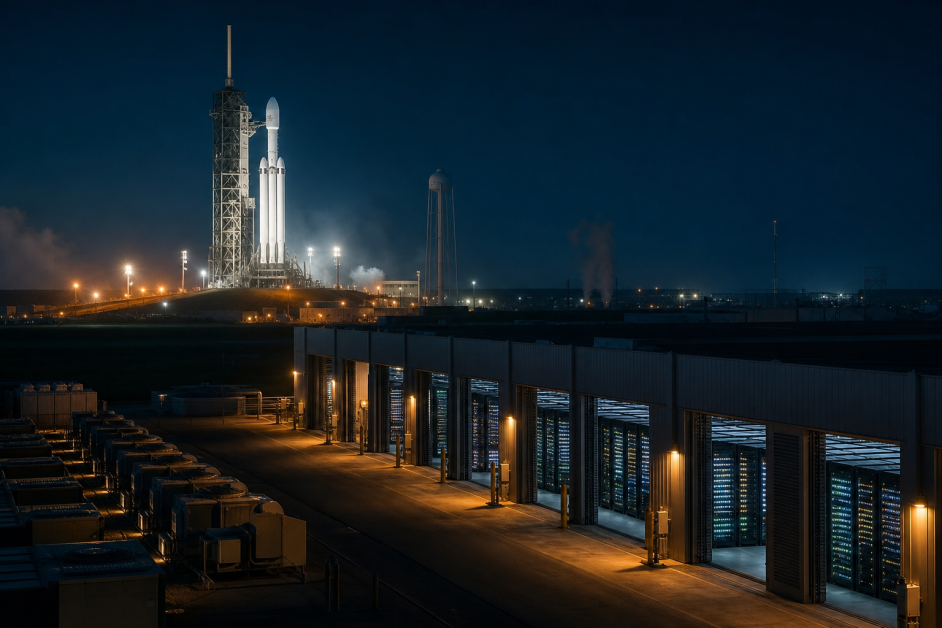
SpaceX’s (SPCX ) AI segment nearly tripled its revenue in the second quarter of 2026, to $2.56 billion, after the company started renting GPU capacity to other AI companies, according to the quarterly report it filed with securities regulators on August 4, 2026. The growth came mostly from new cloud contracts. The losses came from the same place: building the capacity those contracts run on cost more than the contracts have started to pay back.
AI revenue rose 247.5% from $737 million in the same quarter a year earlier, an increase of $1.82 billion that SpaceX attributed primarily to new AI infrastructure contracts, alongside smaller gains in Grok and X subscriptions. The segment’s quarterly operating loss narrowed to $1.26 billion, from $1.52 billion a year ago. Company-wide, revenue reached $7.81 billion, up 91.9%, while the operating loss narrowed to $143 million and the net loss to $541 million, about half the year-ago figure.
The filing is SpaceX’s second report as a public company, following a June 2026 listing on Nasdaq that raised $85.7 billion in net proceeds and left it with $93.5 billion in cash at quarter’s end. It offers the first detailed look at the economics of a rocket and satellite company that now also behaves like a neocloud, selling reserved GPU capacity on fixed monthly fees to customers who cannot get enough compute elsewhere.
What SpaceX’s filing says about the cloud deals
The quarter’s AI growth sits almost entirely in one line. AI solutions and infrastructure revenue, which bundles cloud services with subscriptions, data licensing, and API access to Grok, reached $2.19 billion, up from $311 million a year earlier. SpaceX attributes $1.6 billion of that increase to AI infrastructure alone, which it says began when the company started offering cloud services to customers. Revenue arrives as fixed monthly fees for reserved compute capacity, recognized as the customer draws on it.
The customers are not named in the filing, but their shape is visible. A single AI-segment customer, listed only as Customer B, accounted for 19.5% of SpaceX’s entire consolidated revenue in the quarter, implying roughly $1.5 billion from one buyer. The timing points at Anthropic, which on May 6, 2026 signed an agreement with SpaceXAI for access to Colossus 1, a cluster the company describes as holding more than 220,000 NVIDIA GPUs including H100, H200, and GB200 accelerators. SpaceX told shareholders on its August 4 webcast that it is building AI compute capacity at a pace it believes no one else matches.
The capex line shows what that belief costs. SpaceX spent $18.37 billion on capital expenditures in the quarter, of which $15.83 billion went to the AI segment, against $749 million of AI capex a year earlier. Installed GPU capacity reached 1.4 gigawatts of nameplate power draw, up from 0.4 gigawatts a year ago, with construction in progress on the balance sheet nearly tripling since December 2025 to $12.55 billion, much of it AI infrastructure not yet in service. For the first half of 2026, AI segment capex totaled $23.55 billion.
The fine print on SpaceX’s cloud revenue
The filing attaches real conditions to the growth. SpaceX says a significant portion of its AI infrastructure revenue is concentrated in a small number of customers, and that its cloud agreements run on fixed monthly fees that, after an initial capacity ramp, either side can terminate on 90 days’ notice. Backlog across the whole company stood at $47.46 billion as of June 30, 2026, about 56% of which SpaceX expects to recognize within a year.
The buildout is also increasingly debt-financed, through a structure worth watching. In April 2026, a SpaceX subsidiary leased AI hardware from Valor Equity Partners, a firm founded and run by SpaceX director Antonio Gracias, in arrangements the filing treats as financings rather than true leases. Related-party debt tied to those agreements reached $13.33 billion by June 30, 2026, up from $4.51 billion at the end of 2025, and generated $327 million of interest expense in the quarter. Total debt stood at $38.43 billion, including $25 billion of senior unsecured notes SpaceX sold in June 2026 at a weighted average coupon of 5.855%.
What happens next for SpaceX’s compute build
The filing sets several dated markers. SpaceX expects its $60 billion acquisition of Cursor, the AI coding company it agreed to buy in June 2026 for stock, to close in the third quarter of 2026 once regulators sign off; Cursor is already a compute customer under a separate GPU cluster agreement. Its purchase of Mesh Optical Technologies, a maker of optical transceivers for data-center networking, closed on July 6, 2026. First interest payments on the June notes fall due January 15, 2027, and $22.24 billion of the company’s $27.96 billion in non-cancelable commitments, mostly AI infrastructure and third-party cloud capacity, comes due in 2027.
Whether the neocloud economics work will show up in the spread between the two trajectories now visible in the filing: AI revenue that tripled in a year, against an AI capex line that grew twenty-fold over the same period. The next installment arrives with the third-quarter report.
