

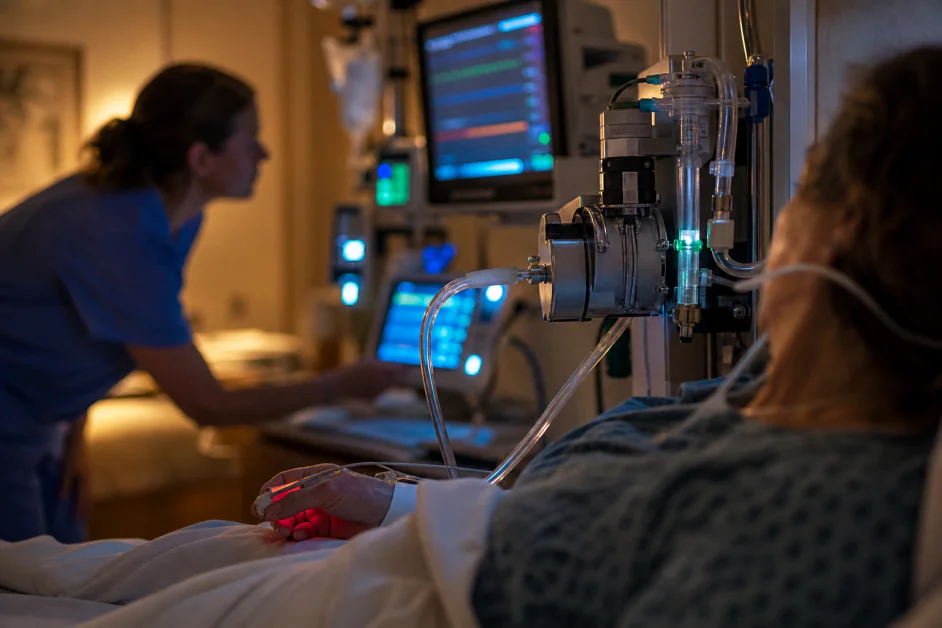
An automated controller held hospitalized adults inside their prescribed oxygen range 85% of the time, against 63% for patients whose oxygen flow was adjusted by hand, in a randomized trial published on August 3, 2026 in JAMA Internal Medicine.
The trial was led by researchers at the University of Colorado Anschutz School of Medicine and enrolled 300 adults at four US hospitals between May 6, 2024 and November 17, 2025, with the protocol registered before the first patient. Participants were admitted with acute respiratory illness, trauma, burns or after acute surgery, and were receiving 1 to 10 liters of supplemental oxygen a minute. Of those enrolled, 152 were assigned to the automated system and 148 to usual clinician management. Both groups got the same oxygen prescription: a target blood-oxygen saturation of 93%, acceptable anywhere from 90% to 96%.
How the controller works
The device is the O2matic PRO100, built by a Danish company of the same name. It reads a fingertip pulse oximeter continuously and moves flow between 0 and 15 liters a minute to hold saturation inside the band a clinician sets, alarming staff when a reading needs a person. The trial’s full name, Strategy to Avoid Excessive Oxygen Using Autonomous Oxygen Titration Intervention, points at the mechanism: trend-based closed-loop control on a single physiological signal, with the autonomy sitting in the feedback loop rather than in a predictive model.
In current practice, nurses and respiratory therapists read saturation and reset the flowmeter every one to two hours in intensive care and every four to eight hours on general wards, leaving patients to drift between checks. “Oxygen is one of the most widely used therapies in medicine yet even in 2026, it is still managed largely through repeated manual adjustments made by clinicians,” said Adit Ginde, professor of emergency medicine and the trial’s principal investigator, in CU Anschutz’s announcement of the results.
The PRO100 carries a European CE mark and is awaiting US market clearance, so the trial ran under an FDA investigational device exemption with devices rented for research. O2matic had no role in the study’s design, data collection, analysis or the decision to publish. The FDA has meanwhile been clearing a steady run of algorithm-driven products, from an updated contraception algorithm to a multiport surgical robot.
What the trial measured
Across the 72 hours after randomization, measured by two pulse oximeters per patient:
- Time in the 90% to 96% target range: 85% with the controller against 63% under clinician management, an adjusted difference of 21 percentage points.
- Time in hypoxemia below 88%, the key secondary endpoint: 2.0% against 3.6%.
- Time in hyperoxemia above 96%: 9.2% against 29.1%.
- Total oxygen delivered: a median 2,310 liters per patient per day against 2,992.
- Safety: no serious adverse events in either group. Four patients in the automated arm reported nosebleeds or discomfort from the cannula or mask, prompting a protocol change requiring humidified oxygen above 8 liters a minute.
Clinical outcomes carried as exploratory endpoints, including in-hospital deaths through day 28, time back to room air and hospital-free days, came out similar between the groups. That is the reach of a 300-patient trial powered on time-in-range; the authors’ position is that correcting low oxygen faster and holding the correction may translate into outcomes at population scale.
The distinction matters for how this fits the rest of clinical AI. Most software reaching the bedside predicts and prompts: Epic’s deterioration alerts, tied to lower hospital mortality, escalate to a clinician who then acts. A closed-loop titrator acts inside limits a clinician has set, which is why it needed a device exemption and a randomized safety readout rather than a software rollout.
The oximeter underneath the loop
The most consequential design choice was who got enrolled. Pulse oximeters are known to read less accurately on darker skin, so the team measured pigmentation directly, following FDA guidance, using both the Monk Skin Tone Scale and the Fitzpatrick scale. Of the 300 participants, 22% were classified light, 56% medium and 22% dark, putting 78% in the medium or dark categories. The advantage held across every prespecified subgroup, pigmentation included. Earlier automated-titration studies ran outside the US in mostly light-skinned cohorts.
The authors are precise about what the loop does not do. The controller titrates to the number its own oximeter reports, so it inherits any error in that measurement instead of correcting it, and better oximetry would raise its ceiling. A sensitivity analysis makes the dependency visible: the gap was 28 percentage points using the device’s oximeter alone and 14 using the hospital monitor’s, both favoring automation. In an invited commentary in the same journal, Melanie Weingart and Michael Matthay of the University of California, San Francisco write that inpatient oxygen therapy remains resource intensive and that technology cutting clinician workload and excess oxygen use is a major unmet need.
What comes next
Usual care in this trial ran better than the historical comparison, with the manual arm holding target 63% of the time against roughly 40% to 50% in earlier studies. The authors call that enhanced usual care and note the margin could widen where staffing is thinner and checks less frequent. The group’s earlier stepped-wedge trial of more than 12,000 trauma patients, published in March 2025, established that this saturation target safely cuts oxygen use without more hypoxemia or deaths.
The next setting is the one Vik Bebarta, chair of emergency medicine at CU Anschutz and a US Air Force Reserve colonel, described in the announcement: “When you are caring for a wounded service member hours from a hospital, oxygen runs short and so does the medic’s attention.” That follow-on project, AURORA, is ruggedizing the PRO100 for vibration and altitude and will randomize patients on ground ambulance and helicopter transport services, with $4.7 million in Defense Department funding and Air Force simulation work alongside it, tracking the same time-in-target measure that carried the hospital trial.
