

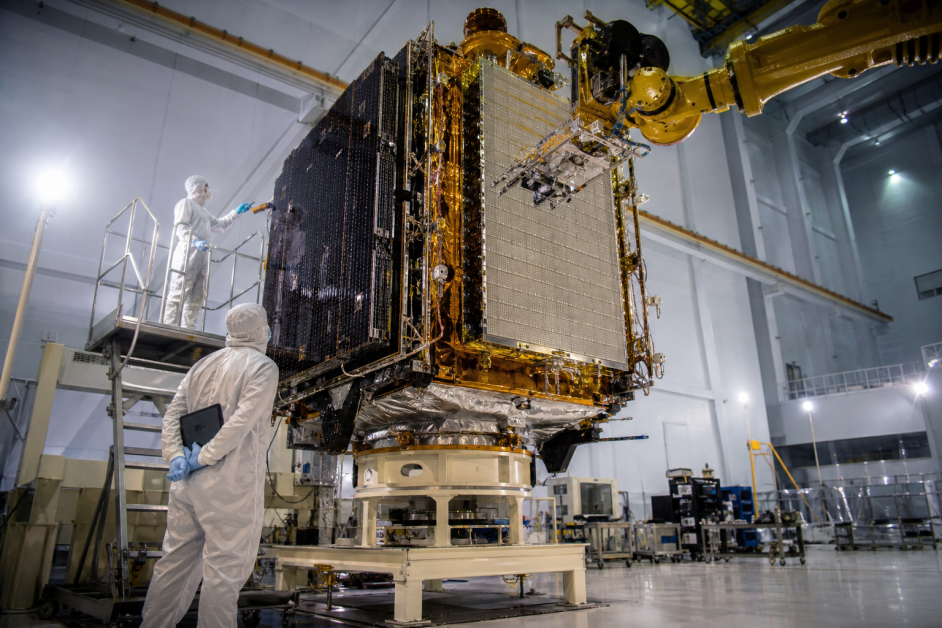
Satellite manufacturer K2 Space has raised $500 million in a Series D round that values the company at $6.8 billion, as Bloomberg first reported on July 30, 2026. Kleiner Perkins and Iconiq co-led the round, with Lightspeed Venture Partners, Alphabet’s growth fund CapitalG, and Altimeter Capital Management among the other backers.
The valuation is the part worth sitting with. K2 announced a $250 million Series C at a $3 billion valuation in December 2025, led by Redpoint. Seven months on, a new syndicate has written a check twice that size at more than twice the price. K2 said at the Series C that it had raised over $450 million since its 2022 founding, and the round before that was a $110 million Series B in February 2025. The Series D roughly doubles the company’s lifetime funding in a single step.
The bet on bigger satellites
K2 was founded by brothers Karan and Neel Kunjur, both former SpaceX (SPCX ) engineers, on a thesis that ran against a decade of industry orthodoxy. As the rest of the sector shrank spacecraft to cut launch costs, K2 made them larger, wagering that cheap heavy lift would reward whoever had the most power-hungry platform ready to fly when it arrived. “The future is higher power,” Karan Kunjur, K2’s co-founder and CEO, told TechCrunch ahead of the company’s first full satellite launch.
Power is the product. The Mega Class bus generates 20 kW, which K2 puts at roughly ten times what comparable platforms in its class deliver, at a cost the company gives as about $15 million per satellite. Its first production spacecraft, Gravitas, flew in March 2026 with 12 payloads from the Department of Defense and commercial customers, underwritten by a $60 million US Space Force contract. K2’s mission page lists Gravitas as operational on orbit. The 180,000-square-foot Torrance, California factory behind it is tooled for 100 satellites a year.
The propulsion is what makes that factory rate matter commercially. K2’s 20 kW Hall-effect thruster is designed to let a satellite climb from low Earth orbit to medium Earth orbit under its own power in under 90 days, which the company says lets it stack four times as many spacecraft onto a single launch and field a constellation with fewer rockets.
Why the capital is arriving now
Two demand curves are converging on high-power satellites, and both were visible before this round priced.
The commercial one has a name and a purchase order. SES is building meoSphere, its next-generation medium-Earth-orbit network, on an initial 28 K2 platforms rated at 20 kW each, targeted for operation by 2030. SES describes the network as a backbone in space: optical satellite-to-satellite links running up to 100 Gbps, with onboard edge computing and storage so customer data can be processed in orbit rather than flushed to the ground first. That is a paying operator putting the case for 20 kW in writing.
The defense one is quieter and older. K2 hired John Plumb, the former Assistant Secretary of Defense for Space Policy, as head of strategy in January 2025, and the Space Force money behind Gravitas predates any of the company’s commercial constellation work. Bloomberg characterized K2’s satellites as built for data-heavy communications and defense missions, which tracks with the order book.
CapitalG’s presence is the detail investors on this beat will notice. Alphabet’s growth fund lists its investment areas as enterprise infrastructure, security and data, fintech, and consumer marketplaces, and it is arriving on a satellite-bus cap table while hyperscalers weigh whether training and inference workloads belong in orbit at all. Capital has been moving that direction for months: Cowboy Space raised $275 million at a $2 billion valuation in May 2026 to build orbital AI data centers, and terrestrial providers have been chasing the adjacent classified and national-security compute market.
What ships next
K2’s stated roadmap runs through Giga, a 100 kW platform designed for Starship and New Glenn that the company has pitched for AI-scale compute on orbit, networks spanning multiple orbits, and mass-produced telescopes. Kunjur has said the 100 kW design is already taped out across the factory floor, and that K2 plans 11 satellites over the next two years, with customer constellations beginning deployment in 2028.
The next hardware milestone is Trinity, the three-satellite mission K2 contracted with SpaceX to fly into low, medium, and geostationary transfer orbits on a single Falcon 9 in 2027. Before that, the SES pathfinder flights begin putting K2 buses under a paying operator’s payloads, the first of a series the two companies plan to fly together over the next three years.
